India now has more than 1,12,000 government-recognized startups and 108+ unicorns — the third-largest startup ecosystem in the world. Yet a hard truth sits underneath that headline: most of these startups will not survive their first five years, and marketing waste is one of the quiet reasons why.
Not because founders don’t work hard. Because most startups copy generic “digital marketing tips” written for the US or UK market, without accounting for how differently Indian consumers discover, evaluate, and buy — through WhatsApp, vernacular content, price-comparison behaviour, and a mobile-first, data-conscious internet.
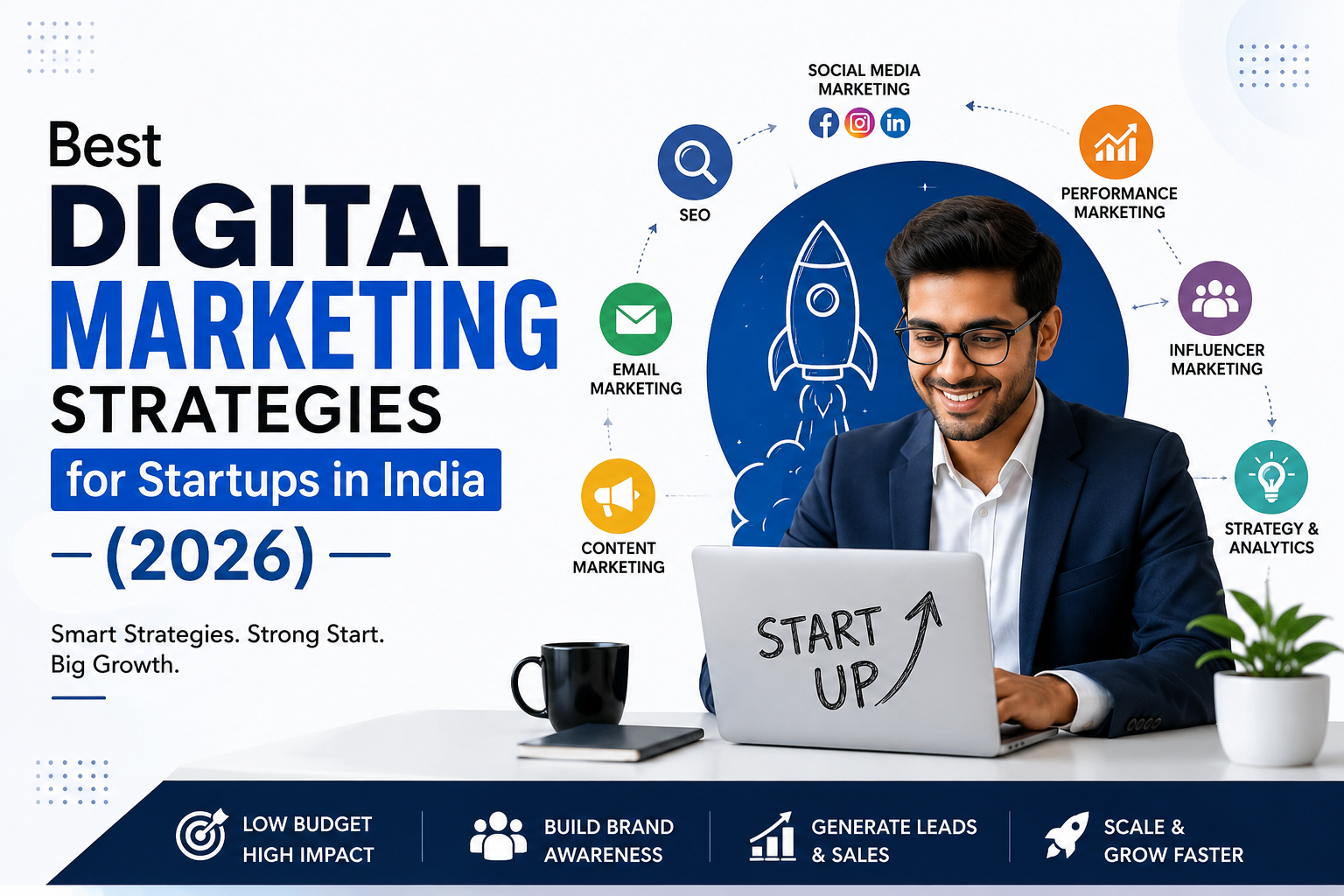
At Branding Dev, we’ve built and executed marketing strategy for early-stage brands across categories, and the pattern is consistent: startups that grow efficiently don’t do “more marketing.” They sequence a small number of channels correctly for their stage, budget, and audience. This guide breaks down exactly what that sequencing looks like for an Indian startup in 2026.
Why 2026 Is a Different Game for Digital Marketing in India
A few shifts make 2026 meaningfully different from even two years ago, and they change where your first rupee of marketing budget should go:
- Digital has overtaken TV. Digital media now claims roughly 41% of India’s total ad expenditure, having crossed television for the first time, with digital ad spending crossing an estimated ₹40,800 crore in FY 2024-25 — a 29% jump year-on-year.
- The internet base is enormous and still growing. India had crossed roughly 1.03 billion internet users by the end of 2025, at close to 70% penetration, according to DataReportal’s Digital 2026 India report — with a large share of new users coming from tier-II and tier-III towns as 5G and public Wi-Fi expand.
- AI is now table stakes, not a differentiator. Surveys show a large majority of CMOs are actively investing in AI/ML for personalization, and tools for automated targeting, multilingual ad creation, and predictive bidding are now standard in platforms like Google and Meta — which means manual, unoptimized campaigns fall behind faster than before.
- Budgets are getting more honest. Realistic monthly digital marketing budgets for Indian startups and SMEs in 2026 typically fall between ₹25,000 and ₹2,50,000, depending on ambition — with ad spend to platforms tracked separately from agency or execution fees.
The takeaway: the channels available to you have matured, but so has competition on them. A scattershot approach — a boosted Instagram post here, a Google ad there — no longer compounds. A sequenced strategy does.
Step 1: Get Your Foundation Right Before You Spend a Rupee
Every high-converting campaign we’ve run for early-stage brands starts with three unglamorous questions most startups skip:
- Who exactly is the first 1,000-customer buyer? Not “urban millennials” — their city tier, income band, buying trigger, and where they currently spend time online.
- What is the one problem you solve better/cheaper/faster than the obvious alternative? If this isn’t a single clear sentence, no amount of ad spend will fix a fuzzy positioning.
- What can you actually afford to burn while you learn? Treat your first 60-90 days of marketing spend as a research budget, not a growth budget. You’re paying to learn which message and channel convert — the scaling comes after.
Skipping this step is the single biggest reason startup marketing budgets get burned without results.
Strategy 1: SEO and Content Marketing — Your Compounding Asset
Paid ads stop the moment you stop paying. SEO and content are the only channels where month 12 costs you the same as month 1 but returns far more, because the content you publish keeps ranking and working.
What actually works for startups, not just theory:
- Answer real buyer questions, not vanity keywords. A logistics startup ranking for “how to reduce last-mile delivery cost in India” will convert better than one chasing “logistics company” (too broad, too competitive, wrong intent).
- Local and city-specific SEO pages if you serve specific geographies — Ahmedabad, Surat, Bengaluru-specific landing pages consistently outperform one generic “India” page for service businesses.
- Publish comparison and “vs” content early. Buyers in India research heavily before purchasing, especially B2B and considered purchases. “X vs Y” and “best [category] in India” content captures this research phase.
- Don’t ignore technical SEO. A slow, unindexed website kills all the content effort above it. Site speed, mobile usability, and clean URL structure matter more on India’s still-improving average mobile network speeds than in mature Western markets.
SEO is slow — expect 4-6 months for meaningful organic traffic — which is exactly why it should start on day one, running in parallel with paid channels, not after them.
Strategy 2: Performance Marketing (Google & Meta Ads) — For Speed, Not Scale (Yet)
Performance ads are how you validate a message quickly while SEO builds in the background.
- Start with Google Search ads for high-intent keywords, not Display or broad Meta awareness campaigns. Search ads catch people already looking for what you sell — the highest-converting traffic you can buy.
- Budget realistically. Most Indian startups start with ₹10,000-₹50,000/month in actual ad spend (separate from agency/management fees), enough for a focused test on 2-3 keyword clusters or one well-targeted Meta audience — not a “spray across five platforms” approach.
- Retarget before you acquire. A retargeting campaign to website visitors and cart-abandoners is almost always cheaper per conversion than fresh cold traffic — set this up before scaling cold acquisition spend.
- Use AI-assisted campaign tools, but supervise them. Automated bidding and audience expansion in Google/Meta’s 2026 tooling can find efficiencies faster than manual setup — but they need a human checking creative fatigue and budget pacing weekly, not “set and forget.”
Strategy 3: WhatsApp and Conversational Marketing — India’s Underused Channel
This is the strategy most global playbooks miss entirely, and it’s one of the highest-converting channels for Indian startups specifically:
- WhatsApp Business API for order updates, abandoned cart recovery, and support consistently gets read and reply rates that email and SMS in India simply don’t match.
- Click-to-WhatsApp ads (from Meta) let a prospect go from ad click straight into a conversation — removing the friction of a landing page form, which matters enormously for trust-sensitive first-time buyers.
- Use it for the consideration stage, not just support. A quick WhatsApp catalog, FAQ auto-responder, or human-assisted sales chat can out-convert a static website for categories like D2C, real estate, education, and services.
Strategy 4: Influencer and UGC Marketing — Built for India’s Creator Economy
India’s creator economy is large, hyper-niche, and far cheaper to access than in the US — this is a genuine startup advantage if used correctly:
- Micro and nano-influencers (10K-100K followers) in a specific city, language, or niche typically deliver better cost-per-acquisition than a single large celebrity influencer, especially for D2C, food, fashion, and wellness categories.
- Vernacular content outperforms English-only content outside metro audiences. If your buyer is in tier-II/III India, Hindi, Gujarati, Tamil, or other regional-language content is not optional — it’s often the difference between being seen and being scrolled past.
- Ask for usage rights on UGC so the same content can be repurposed as paid ad creative — this is often where the real ROI shows up, not the original influencer post itself.
Strategy 5: Email and Marketing Automation — For Retention, Not Just Acquisition
Founders chase new customers and forget the cheapest revenue is from people who already bought once.
- Set up a basic automated sequence on day one: welcome email, post-purchase follow-up, and a win-back sequence for inactive users. This alone recovers revenue most startups are currently leaving on the table.
- Segment by behaviour, not just demographics — someone who abandoned a cart needs a different message than someone who bought once and went quiet.
- Keep subject lines specific and benefit-led rather than generic — this single change typically has the largest impact on open rates of anything in an email program.
Strategy 6: Local and Hyperlocal Marketing — Where the Next Wave of Growth Is
With internet access expanding fastest in tier-II and tier-III towns as 5G and public Wi-Fi roll out, startups assuming their growth will only come from metro cities are leaving an increasingly large market unaddressed.
- Google Business Profile optimization for any startup with a physical or service-area presence — this remains one of the highest-ROI, lowest-cost tactics available.
- Local-language landing pages and ad creative for expansion cities, rather than translating your metro campaign word-for-word.
- Local partnerships and community-level marketing (societies, local business associations, campus ambassadors) often outperform paid digital in smaller towns where trust is built offline first.
How Much Should You Actually Spend?
There’s no universal number, but a workable framework for Indian startups in 2026:
| Monthly Budget | What It Realistically Buys |
|---|---|
| ₹15,000 – ₹50,000 | Basic SEO + social media management + one small, focused ad test |
| ₹50,000 – ₹2,00,000 | Multi-channel execution: SEO + performance ads + WhatsApp/email automation + content |
| ₹2,00,000 – ₹10,00,000+ | Full-funnel marketing with dedicated channel specialists, likely via an agency or in-house team |
A useful rule of thumb: below roughly ₹2-3 lakh/month, an agency relationship usually outperforms building an in-house team, because the agency’s cross-client expertise offsets its overhead. Above ₹10 lakh/month, in-house specialists start to win because volume justifies deep specialization and institutional knowledge of your specific customers becomes the real edge.
Common Mistakes Startups Make (That Quietly Burn Budget)
- Running paid ads to a website that isn’t built to convert. Fix conversion rate on the site before scaling ad spend — otherwise you’re just paying more to leak more.
- Chasing every new platform instead of doing 2-3 channels well. Depth beats breadth in the first 12 months.
- No tracking setup before campaigns launch. If you can’t attribute a sale to a channel, you can’t tell what to scale or kill.
- Treating marketing as a one-time project instead of an ongoing, measured system that gets optimized monthly.
Final Thought
The startups that grow efficiently in India in 2026 aren’t the ones spending the most — they’re the ones sequencing SEO, performance ads, WhatsApp, and retention correctly for their specific stage and budget, and measuring relentlessly. Get the foundation right, pick 2-3 channels, and let compounding do the rest.
Need help building this out for your startup? Talk to Branding Dev — we help early-stage brands in Ahmedabad and across India build strategy-first digital marketing systems, not just run ads.
FAQs
What is the best digital marketing strategy for a new startup in India? There’s no single “best” channel — the right starting mix is usually SEO (for long-term compounding traffic), a focused Google Search ads test (for fast validation), and WhatsApp-based engagement (for India-specific conversion), sequenced based on your budget and how quickly you need results.
How much should a startup spend on digital marketing in India in 2026? Most early-stage startups realistically start between ₹15,000 and ₹50,000 per month combined ad spend and execution, scaling up as specific channels prove ROI.
Is SEO worth it for a startup with a small budget? Yes — SEO is slower (expect 4-6 months for meaningful traction) but it’s the only channel that keeps compounding without ongoing spend, making it especially valuable for budget-constrained startups.
About the Author
This guide is based on Branding Dev’s hands-on experience building brand identity, websites, and digital marketing strategy for early-stage businesses and startups in Ahmedabad and across India. [Add specific author name, title, and years of experience here for full E-E-A-T credit — e.g., “Written by [Dev Patel], Founder/Digital Marketing Lead at Branding Dev, X years helping startups build go-to-market strategy.”]